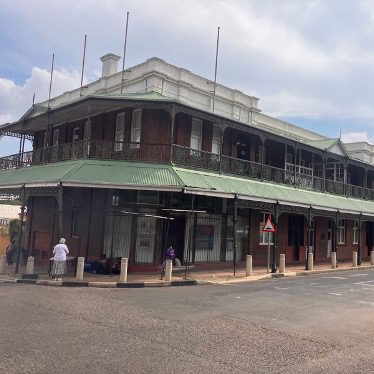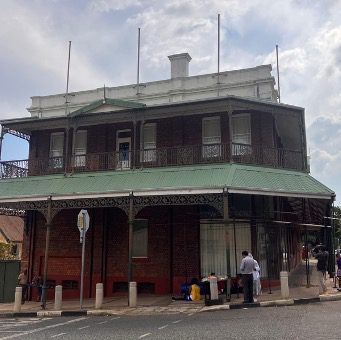
The site is located in the eastern corner of the Johannesburg municipal area, situated on the corner of Berg and Marshall Streets in the historic suburb of Jeppestown. Jeppestown was established as one of Johannesburg’s early suburbs following the 1886 gold discovery, with Marshall Street forming part of the original urban grid pattern that characterised early Johannesburg development. The building stands directly opposite St Mary’s School, creating a significant heritage precinct.
Architectural Description
Salisbury House is a two-storey Victorian commercial building constructed in 1902 as business premises for Mr P. Chat . It was designed by Mckintosh and Moffat Architects in accordance with Johannesburg’s early building regulations, introduced in 1891. The building is an excellent example of late Victorian commercial architecture adapted to South African conditions, combining British colonial design with features suited to the local climate.
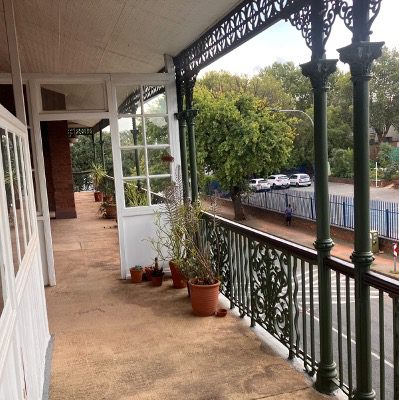
Constructed of load-bearing masonry and cast-iron/steel framed structure, the building features pointed brickwork, white plastered walls, a green corrugated iron hipped roof, chimneys and large glazed shopfronts. Distinctive cast-iron verandas with decorative “broekie lace” extending along both street frontages, while rhythmically arranged sash windows and classical proportions reinforce its Victorian character. Original Victorian pavement lights continue to illuminate the basement.
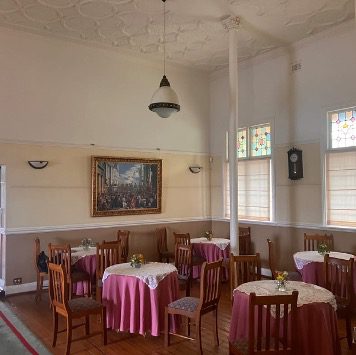
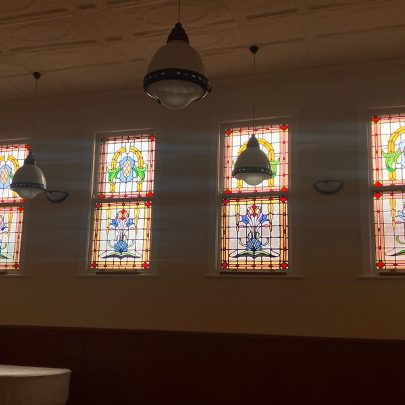
Many important interior features survive, including pressed metal ceilings, stained-glass windows, Oregon pine floors, fireplaces, historic pharmaceutical cabinets, timber joinery, embossed wallpaper, decorative mouldings, air vents, light fittings and the original central staircase.
Conservation works undertaken between 2003 and 2016 introduced improved circulation, kitchen and ablution facilities, upgraded building services and enhanced accessibility. New interventions were carefully distinguished from the original fabric while preserving the building’s architectural integrity in accordance with accepted conservation practice.
Salisbury House forms part of Johannesburg's early urban development following the discovery of gold on the Witwatersrand in 1886. Jeppestown was one of the city's earliest planned suburbs, while Marshall Street developed as an important commercial route linking the city centre with surrounding neighbourhoods.
Constructed in 1902 after the Boer war for businessman P. Chat, the building originally combined retail premises at street level with residential accommodation above, reflecting the mixed-use character of early Johannesburg.
In 1908 the property was purchased by chemist Mr Anderson, who established Anderson's Chemist and renamed the building after his wife, Kate Salisbury, a teacher at nearby St Mary's Diocesan School. Under Anderson's ownership the pharmacy became an important community institution. During the First World War, two shops were converted into residential flats to accommodate changing urban needs.
Following Anderson's death in 1943, the property remained in commercial and residential use under the ownership of Mr Hansen. In 1974 it was acquired by the Johannesburg Community Development Board before being transferred to the Johannesburg City Council in 1977. Like many buildings in Johannesburg's inner city, Salisbury House subsequently experienced decades of neglect, reflecting the wider decline of the historic urban core.
Its architectural significance was nevertheless recognised during the 1970s when the Johannesburg branch of the Simon van der Stel Society included it among the "Top 100 Buildings in Johannesburg to preserve."
A new phase in the building's history began in 2003 when the School of Practical Philosophy leased the property from the Johannesburg Property Company and undertook its restoration for educational use. The project has become a recognised example of successful adaptive reuse, preserving the building's historic character while accommodating contemporary educational and cultural activities. The restored building been further recognised in 2026 through the award of a Blue Heritage Plaque by the City of Johannesburg with support from the Johannesburg Heritage Foundation.

Presumed protected under Section 34 of the National Heritage Resources Act (Act No. 25 of 1999) due to its age and historical value. The building's conservation was guided by the Burra Charter and received declaration from both Provincial Heritage Resource Agency Gauteng (PHRAG) and South African Heritage Resources Authority (SAHRA).
The building contributes to the Jeppestown heritage area and is recognised as a significant heritage asset requiring protection under national heritage legislation.
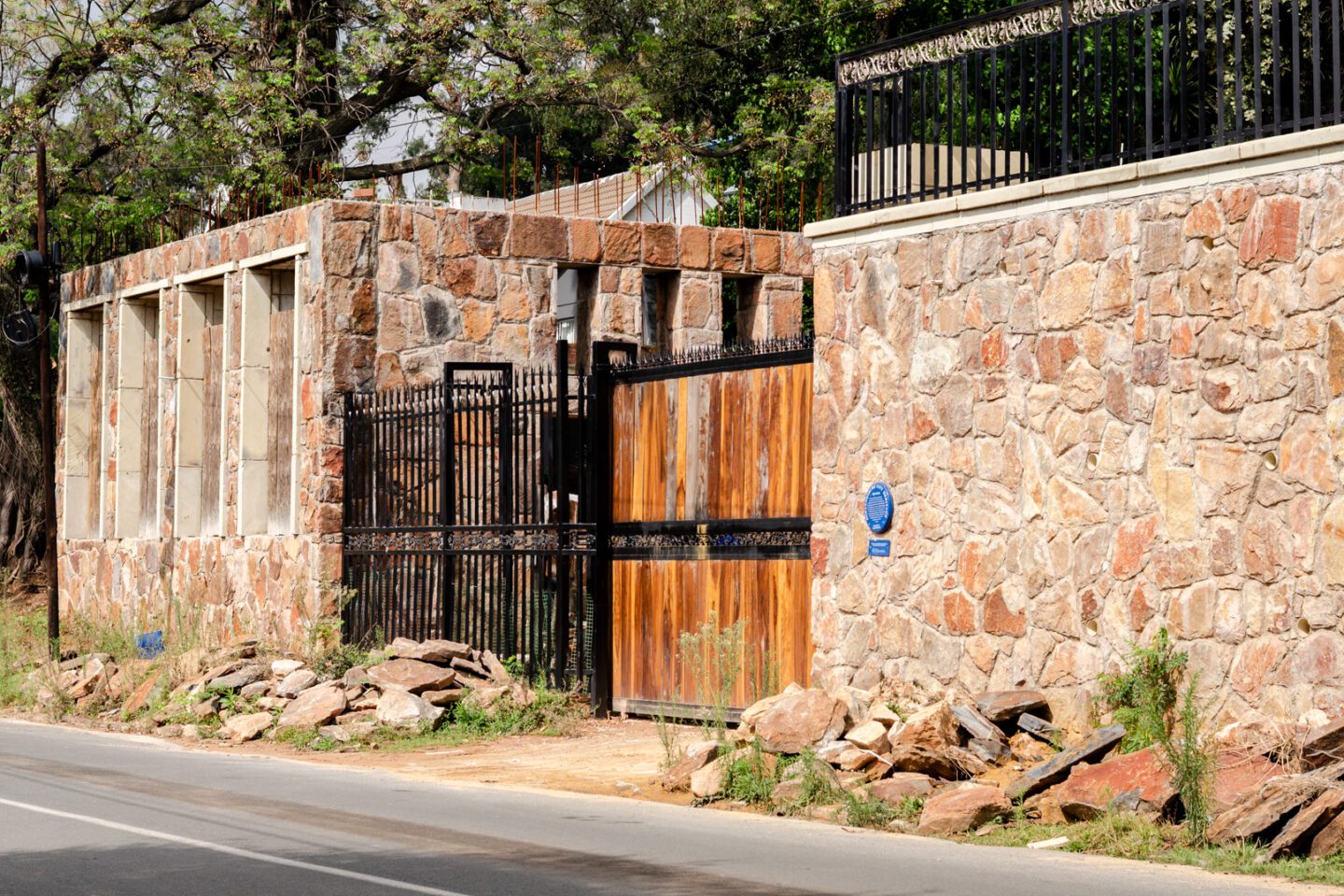
For over twenty years, the City of Johannesburg has awarded blue plaques to sites of heritage significance, aiming to publicly acknowledge and commemorate special buildings and sites, outstanding personalities, freedom struggles, and events that have shaped our city.
A culmination of research gathered over many years, the Online Johannesburg Heritage Register is being launched on Nelson Mandela Day 18 July 2025.
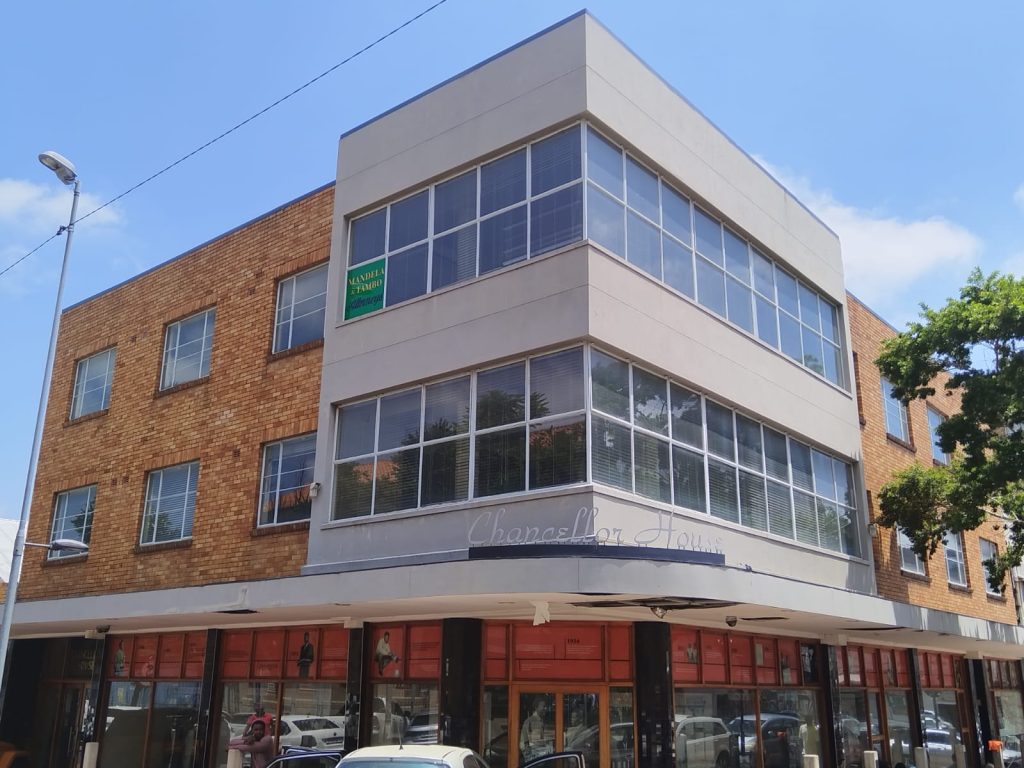
Among the many heritage sites featured is Chancellor House, the downtown offices of Mandela and Tambo Attorneys in the 1950s. After having been vacant and shuttered for more than a decade, this iconic building is being revived and brought to life once again as offices for the Community Development Department, which oversees the City’s Arts, Culture & Heritage Services.