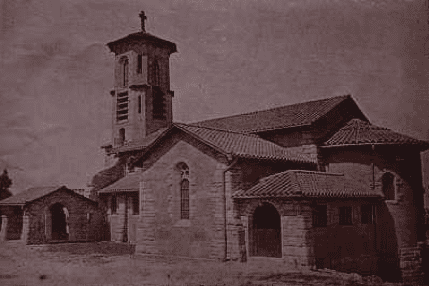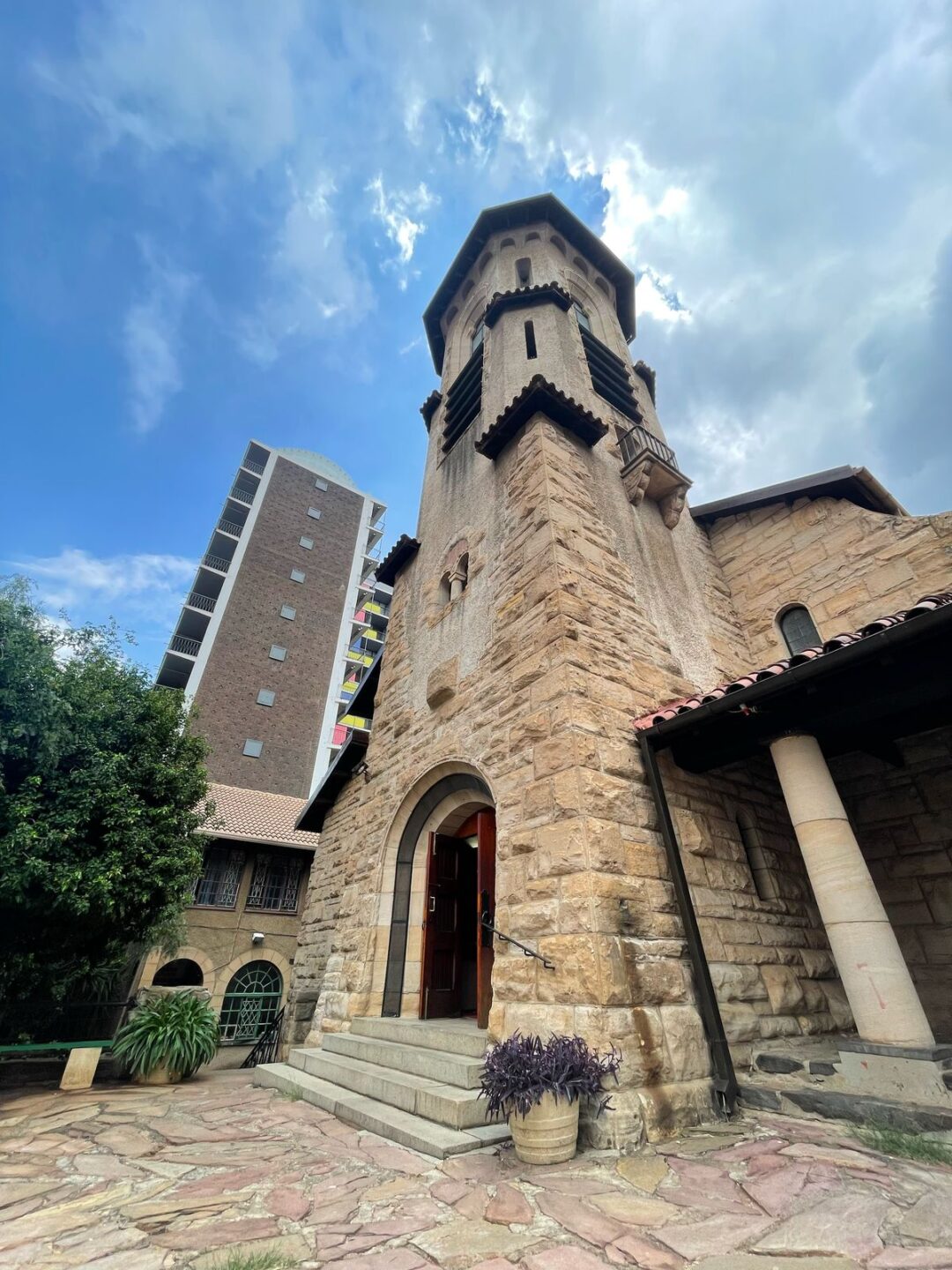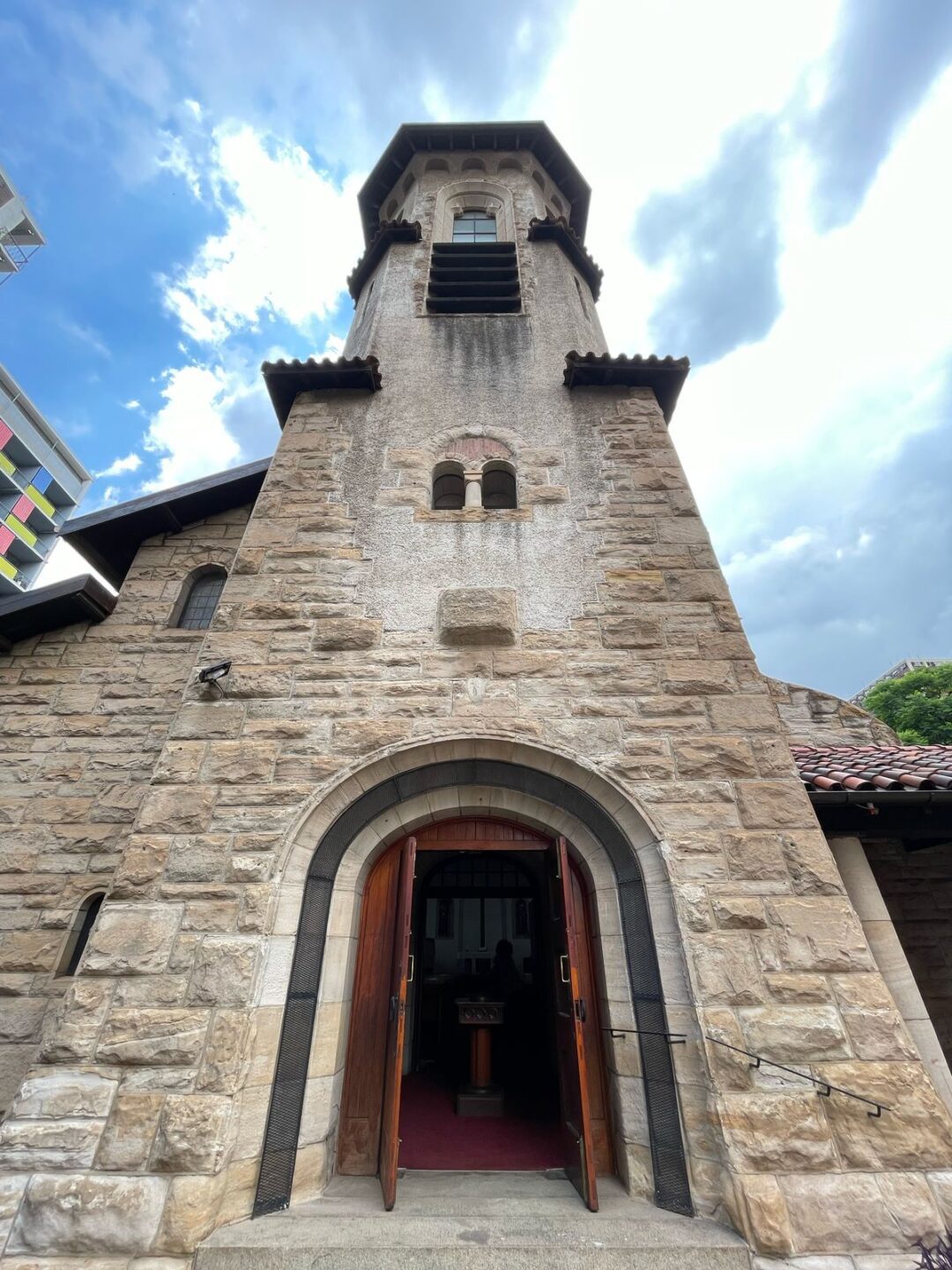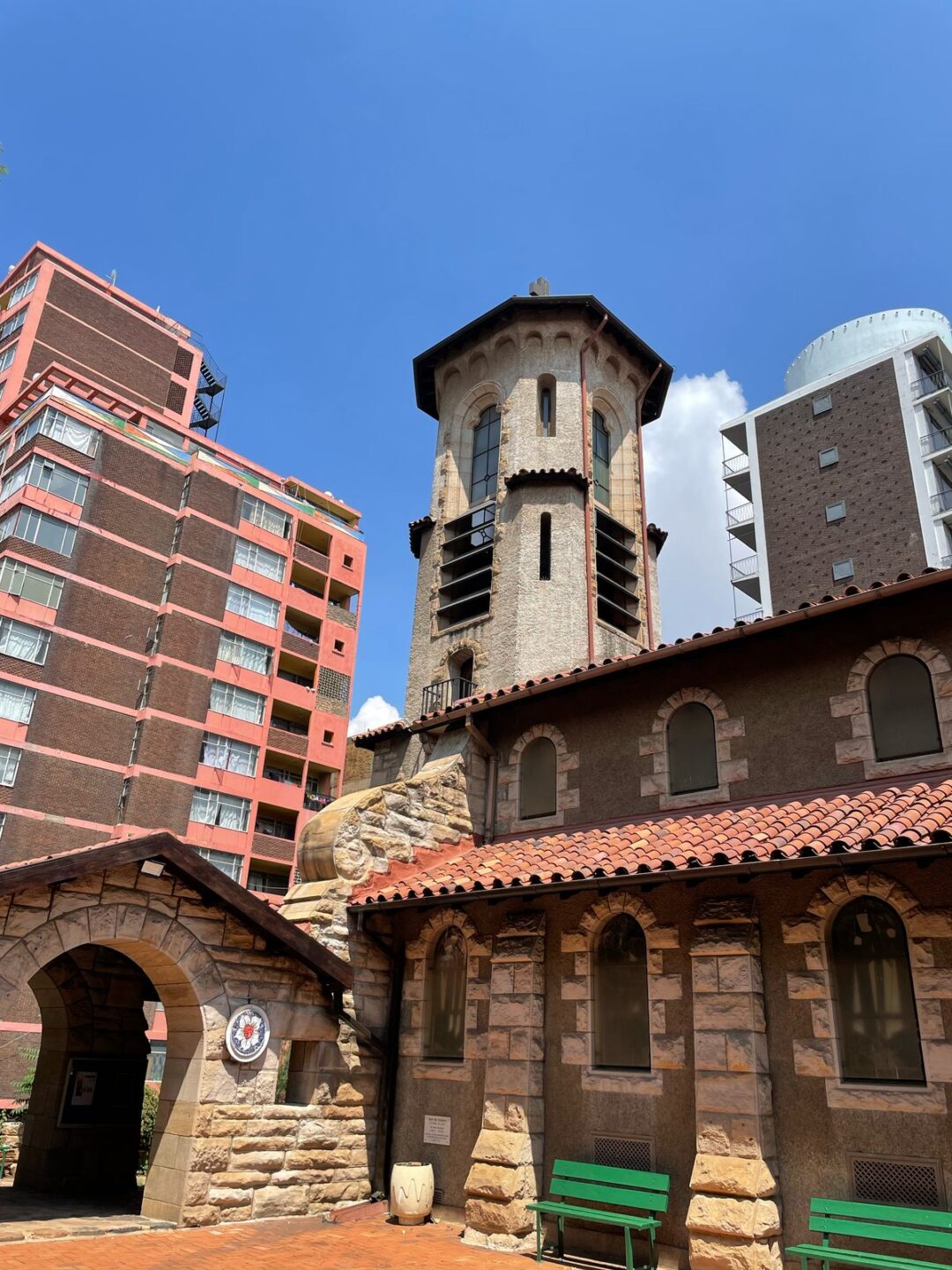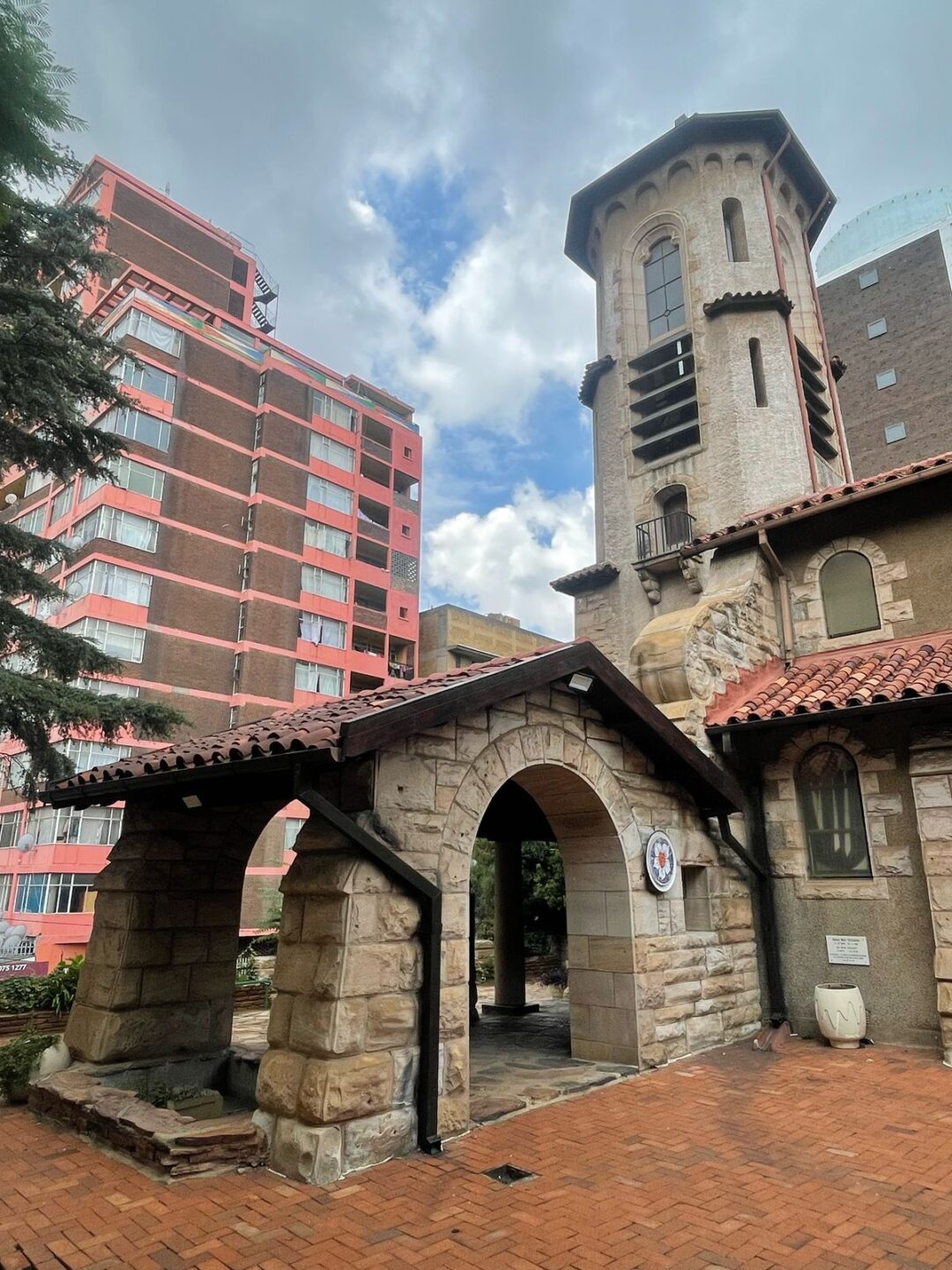
Built in Romanic style, with some Cape Dutch features added.
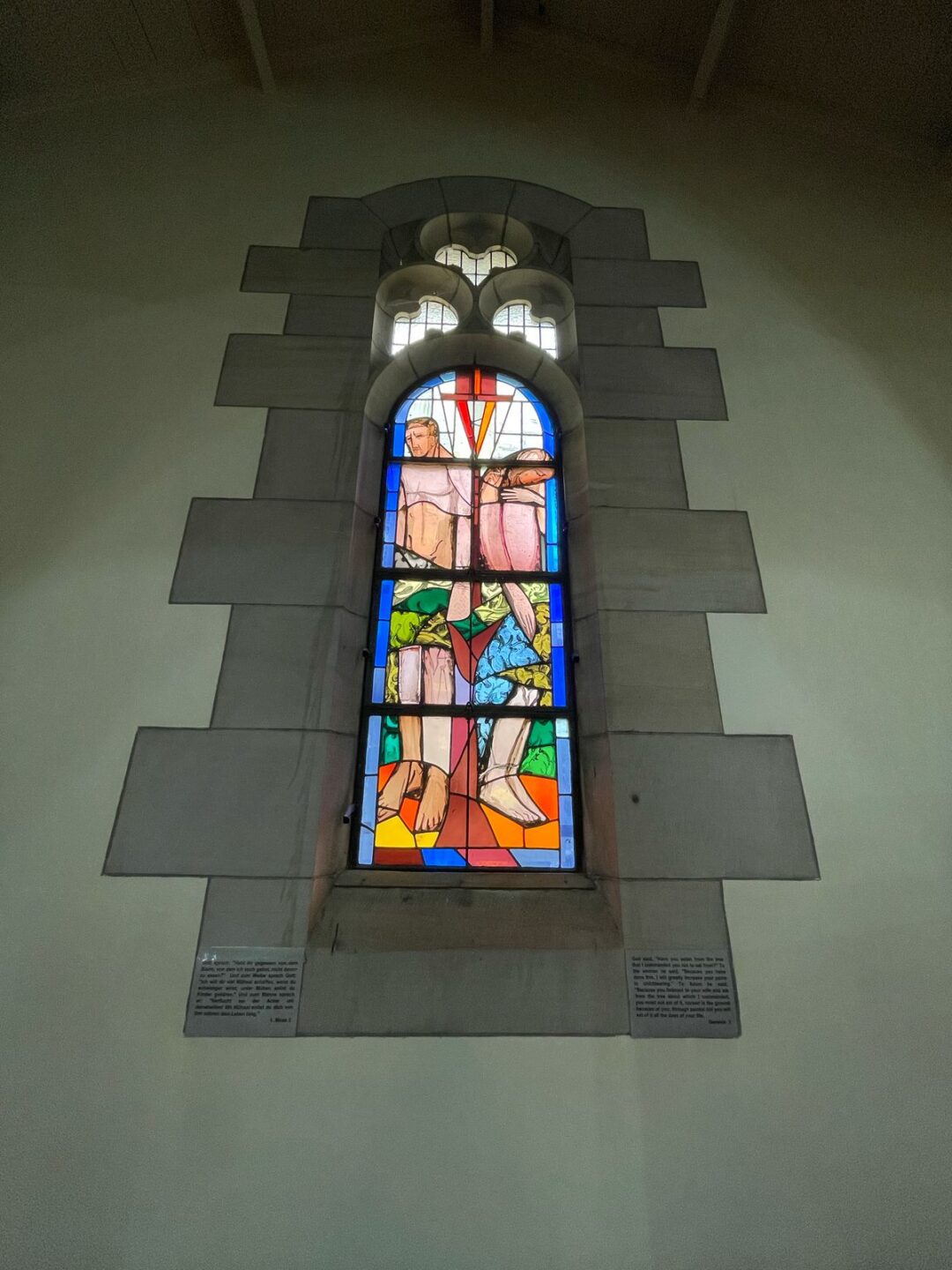
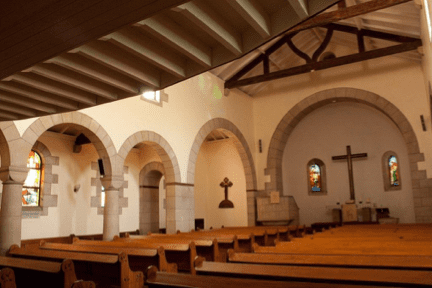
“It’s sandstone foundation runs halfway up to the impressive three-bell tower. Sandstone finishes are evident inside the charming church, in columns and window frames. These finishes are perfectly offset by the long rows of warm-brown wooden benches, striking wooden ceiling beams and the rounded wooden balcony, with it’s tall organ against the back wall. Unusual stained-glass windows contrast with the off-white plaster walls” (Lucille Davie).
Originally, the church held a commanding view over the town, perched as it is on a hill. Today, while surrounded by Hillbrow’s high-rise buildings, the Friedenskirche appears as an oasis of tranquillity in the dense neighbourhood.
“They have a most beautiful antique altar given them by the Kaiser. I am sure it belonged in a Catholic Church! It now stands in the vestry and I would like to see it given special recognition and protection. They moved it when they redecorated the interior – painted the roof which I am sure was dark timber and installed some lovely “Modern” stained glass windows, lectern altar and crucifix” (Flo Bird 2011).
The Friedenskirche congregation was founded as a German Evangelical Lutheran congregation in 1888, two years shortly after the discovery of gold on the Witwatersrand, to minister to German-speaking Protestants, and give the German community a home in a foreign country. The first church was built in the eastern suburb of Doornfontein, where a simple A-framed building was erected, but this soon proved too small.
Later, a fairly large piece of land in Hillbrow was made available to the German community of Johannesburg by the government of the South African Republic headed by Paul Kruger. This site was divided between the Lutheran congregation and the German School.
Funds to construct the present Church in 1912 came from the congregations and supporters in Germany, amongst whom the Prussian royal family figured notably, and members of the German-speaking Jewish business community in Johannesburg.
Flo Bird comments as follows:
“I was involved in its declaration as a national Monument [in 1986] and I was told at that time that Friede meant PEACE not FREEDOM, as it does in Afrikaans. The man who explained this said many of the immigrants had left Germany to escape the War Party or the militant movement. They belonged to the Friedens movement. So our Germans were the peace-loving ones. I don’t know how true that was and I have never checked, but I can imagine that if you had lived through Bismarck’s Prussian Wars and then the armament programme you prefer to be somewhere else”.
For many years the Friedenskirche was at the centre of German cultural life, and the Friedenskirche views itself as a home for all Lutherans in and around Johannesburg. With the change in the population in Hillbrow beginning in the 1980’s the congregation saw a decline in German-speaking membership. The remaining members in the main are old and frail and find it difficult to come to the Friedenskirche every Sunday. Financial support is still given by them.
The vibrant English services attract a growing number of black inner-city residents, coming from all South Africa and other African countries. The congregation decided to face the challenge of being an inner-city church and launched an Outreach Project in 1998, targeting the disadvantaged residents of Hillbrow, particularly children and youth, with cultural and developmental programmes.
There was originally a German school and a pastor’s house, which have made way for the Andre Hugenet Theatre, a small block of flats and a crèche, run by Metro Evangelical Services (MES). A new parsonage was built in 1936 and is now the office building; a second one built in 1954 is now used as a music centre.
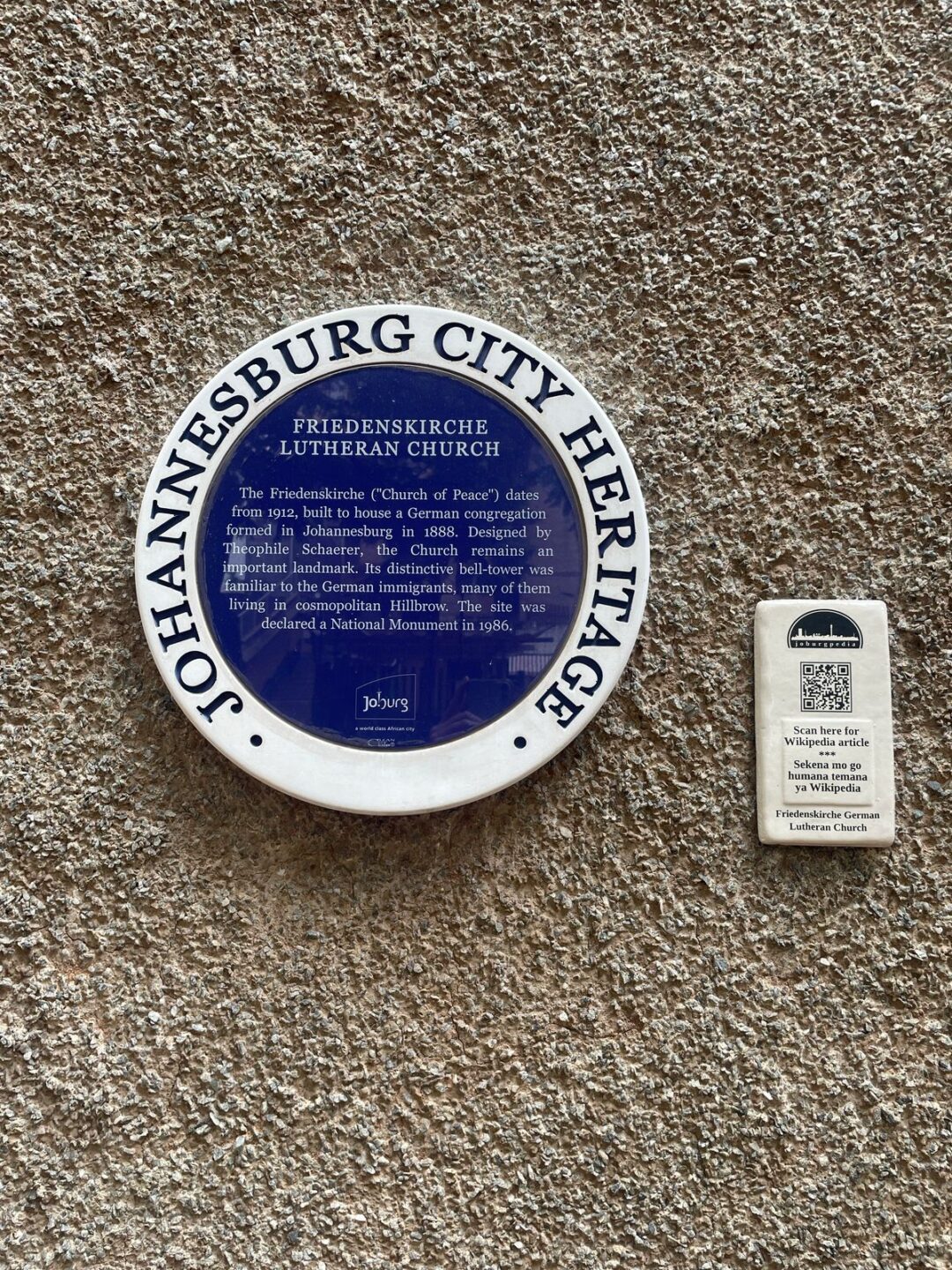
Declared a National Monument in 1986. Currently, the Friedenskirche holds the status of a Provincial Heritage Site.
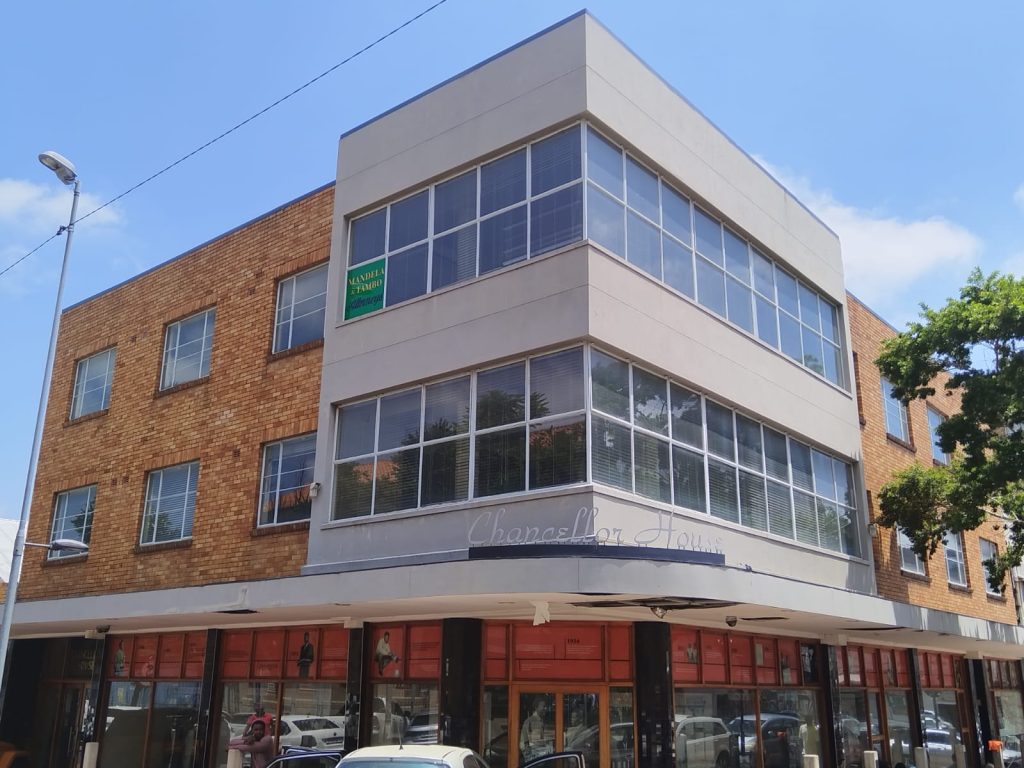
A culmination of research gathered over many years, the Online Johannesburg Heritage Register is being launched on Nelson Mandela Day 18 July 2025.
Among the many heritage sites featured is Chancellor House, the downtown offices of Mandela and Tambo Attorneys in the 1950s. After having been vacant and shuttered for more than a decade, this iconic building is being revived and brought to life once again as offices for the Community Development Department, which oversees the City’s Arts, Culture & Heritage Services.