
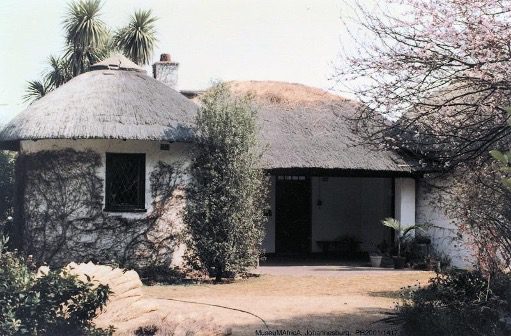
Thatched rondavel including a museum.
It was built on a kraal principle, with two bedroom rondavels abutting a lounge that led on to a stoep, from which a kitchen flowed. The two rondavels do not flow into the dining room, but have outside doors. Kallenbach wished these to be independent structures, as in a conventional kraal. In addition, the house had no passages. The previous owners enclosed the stoep with tall wooden concertina doors, which have been retained, as has the addition of two bedrooms towards the back.
Under the thatched roof is a loft where Gandhi is believed to have slept.
New units for accommodation line the southern edge of the property, built in a low-key modernist mode, and finished in facebrick, clearly distinguished from the historic house.
The house was designed by Kallenbach and Reynold, and built for his own use by the architect Herman Kallenbach. The building plans were approved in June 1907, and the cottage was completed in 1908, when it was still in the country, surrounded by orchards, orange groves and virgin veld.
Originally, the property had a tennis court, completed even before the house, and reflecting Kallenbach’s keen interest in sport and physical well-being. The tennis court however disappeared when the property was sub-divided as the suburb developed.
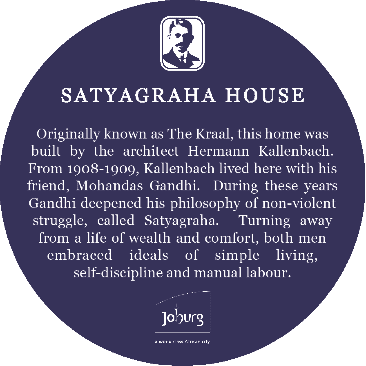
For nearly one and a half years, from 1908-1909, Kallenbach shared the house on Pine Road with his close friend Mohandas Gandhi. Here in Orchards they shared what was in effect an isolated two-man ashram. Later, from 1910-1912, they continued their experiments in communal living while living with others at Tolstoy Farm, a communal settlement which became central to the Satyagraha struggle waged by the Indians of the Transvaal.
Forsaking a life of privilege, Gandhi and Kallenbach embraced ideas of simple living, manual labour and self-discipline. Also around this time, Gandhi deepened the theory and practice of non-violent struggle, which he termed Satyagraha, meaning “Truth-force”. Together with Gandhi, Kallenbach too became deeply involved in the Indian struggle during this period.
On the back of a photograph of the house, Kallenbach wrote (in German):
“The Kraal, our first house, where Gandhi lived with me for several years. In this house the Rev J Doke came many times while writing the book a bout Gandhi ‘An Indian patriot’ ”. 18 Sept 1928 H K
In his book, the first biography written on Gandhi, Rev Joseph Doke wrote:
“I write this in the house in which he usually lives when in Johannesburg. Yonder is the open stoep – there is the rolled-up mattress on which he sleeps”.
In 2009, the Gandhi house was bought by French travel company Voyageurs du Monde, with the aim of turning it into a bed and breakfast and museum, where people would be able to explore Gandhi’s principles. The historic house was restored by heritaqe architect Rocco Bosman, and three additional accommodation units in facebrick added to the site, as well as an additional room attached to the house. The thatched cottage in the garden, plus the two rooms in the house means there are seven guest rooms available. Since 2011, the facility has operated as a guesthouse dedicated to Gandhi and Kallenbach. There are not TVs or aircon in the rooms. No alcohol is served, and the meals are strictly vegetarian, in keeping with Gandhi’s principles of ascetic living. The decor in the house and rooms is simple in earthy colours, with Indian cotton curtains and bed linen. The thatch on the cottage and house was recently replaced. The site now has solar panels, and water tanks.
General Protection: Section 34 (1) Structures under the National Heritage Resources Act, 1999.
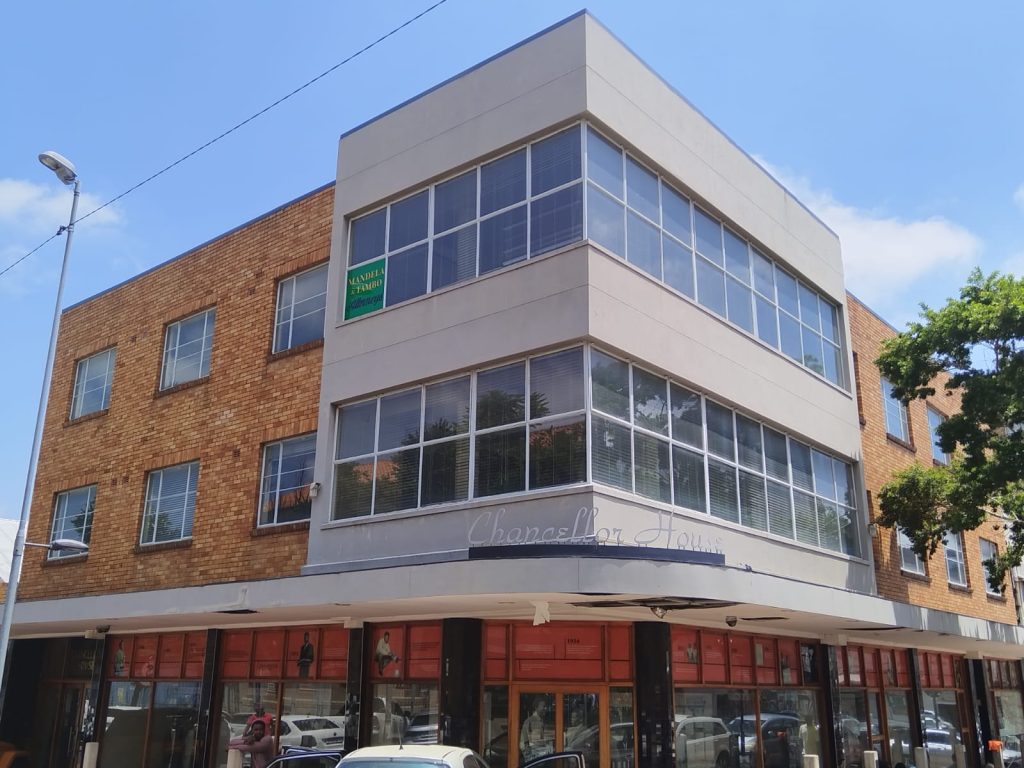
A culmination of research gathered over many years, the Online Johannesburg Heritage Register is being launched on Nelson Mandela Day 18 July 2025.
Among the many heritage sites featured is Chancellor House, the downtown offices of Mandela and Tambo Attorneys in the 1950s. After having been vacant and shuttered for more than a decade, this iconic building is being revived and brought to life once again as offices for the Community Development Department, which oversees the City’s Arts, Culture & Heritage Services.