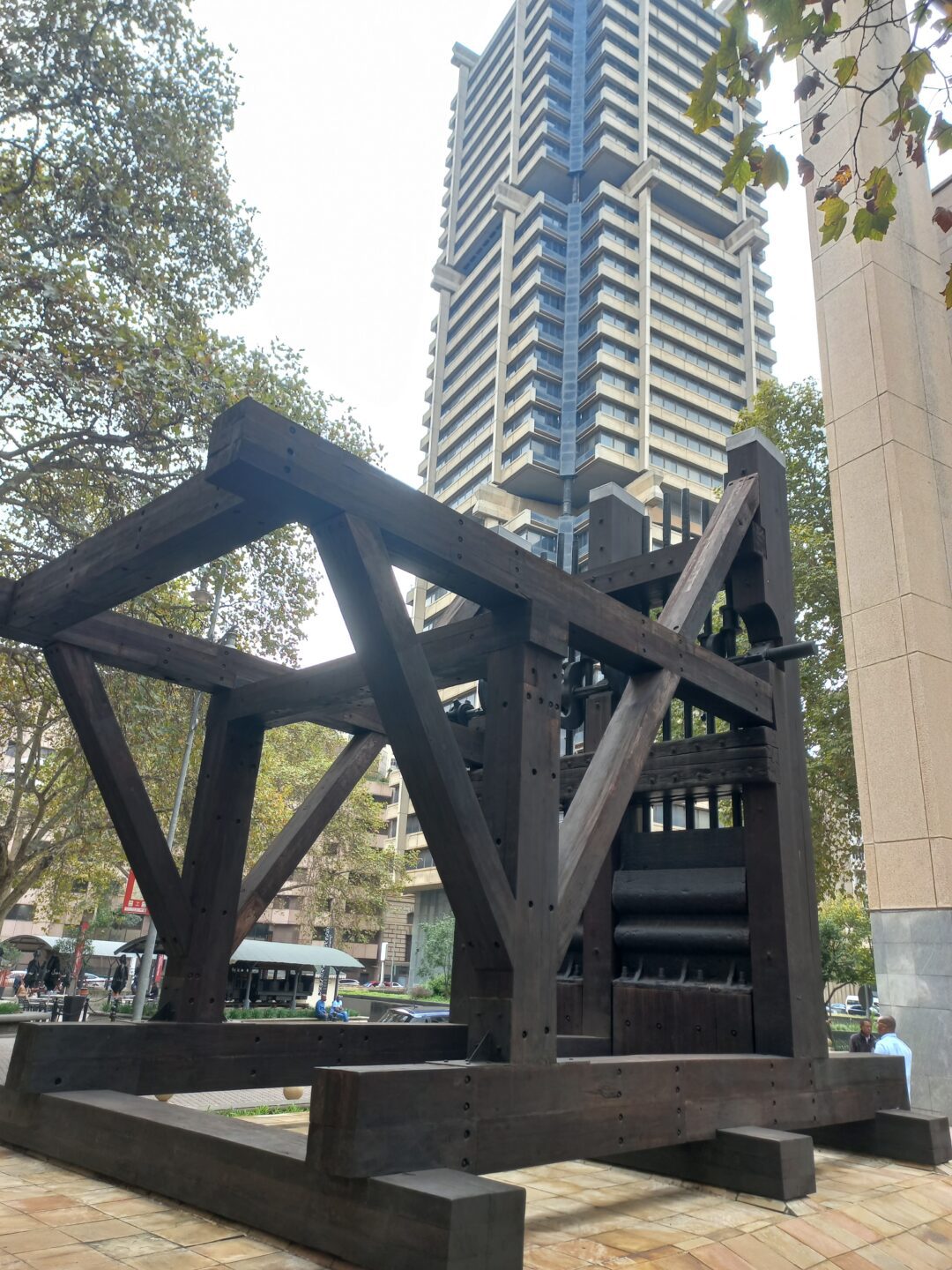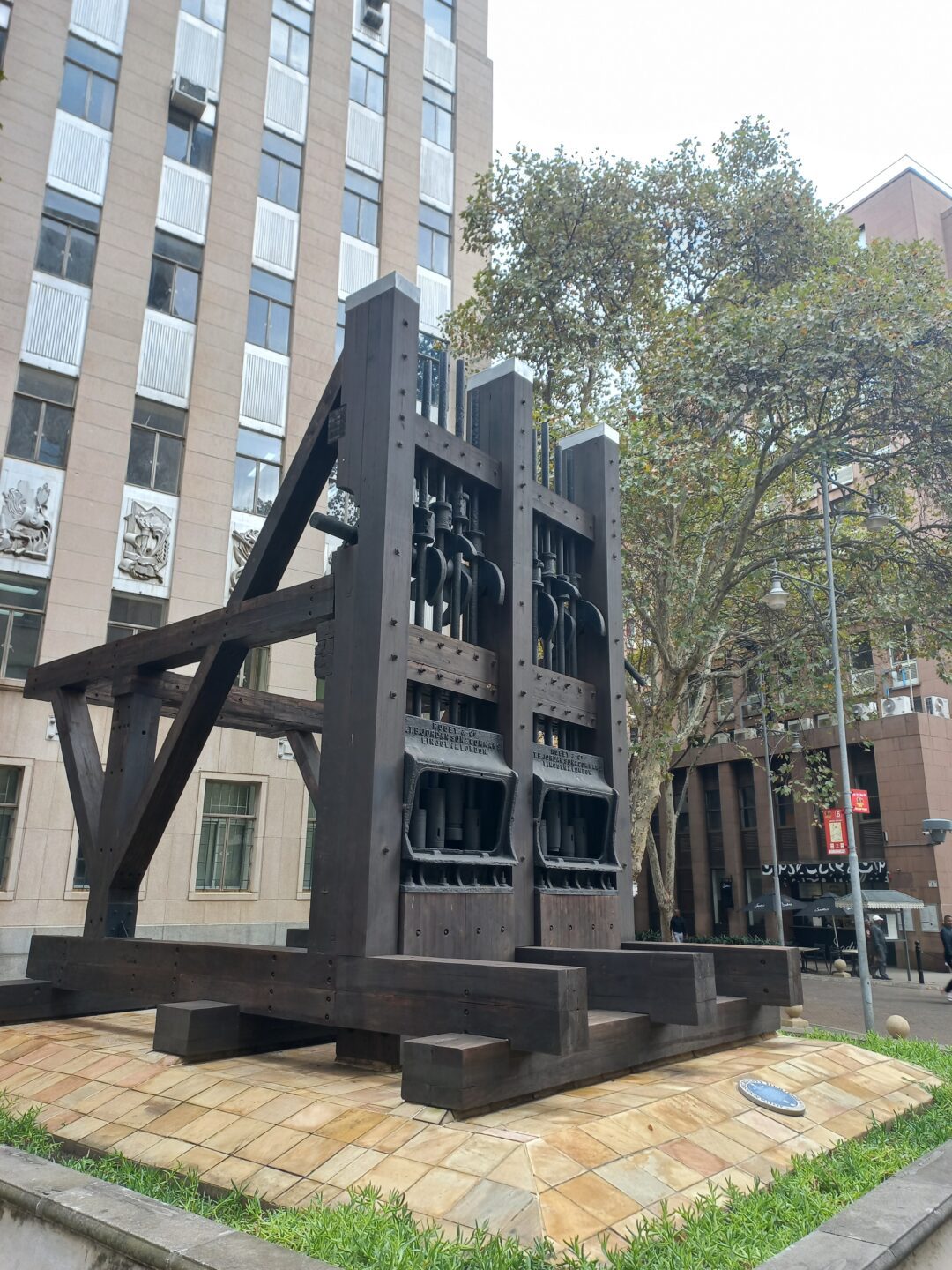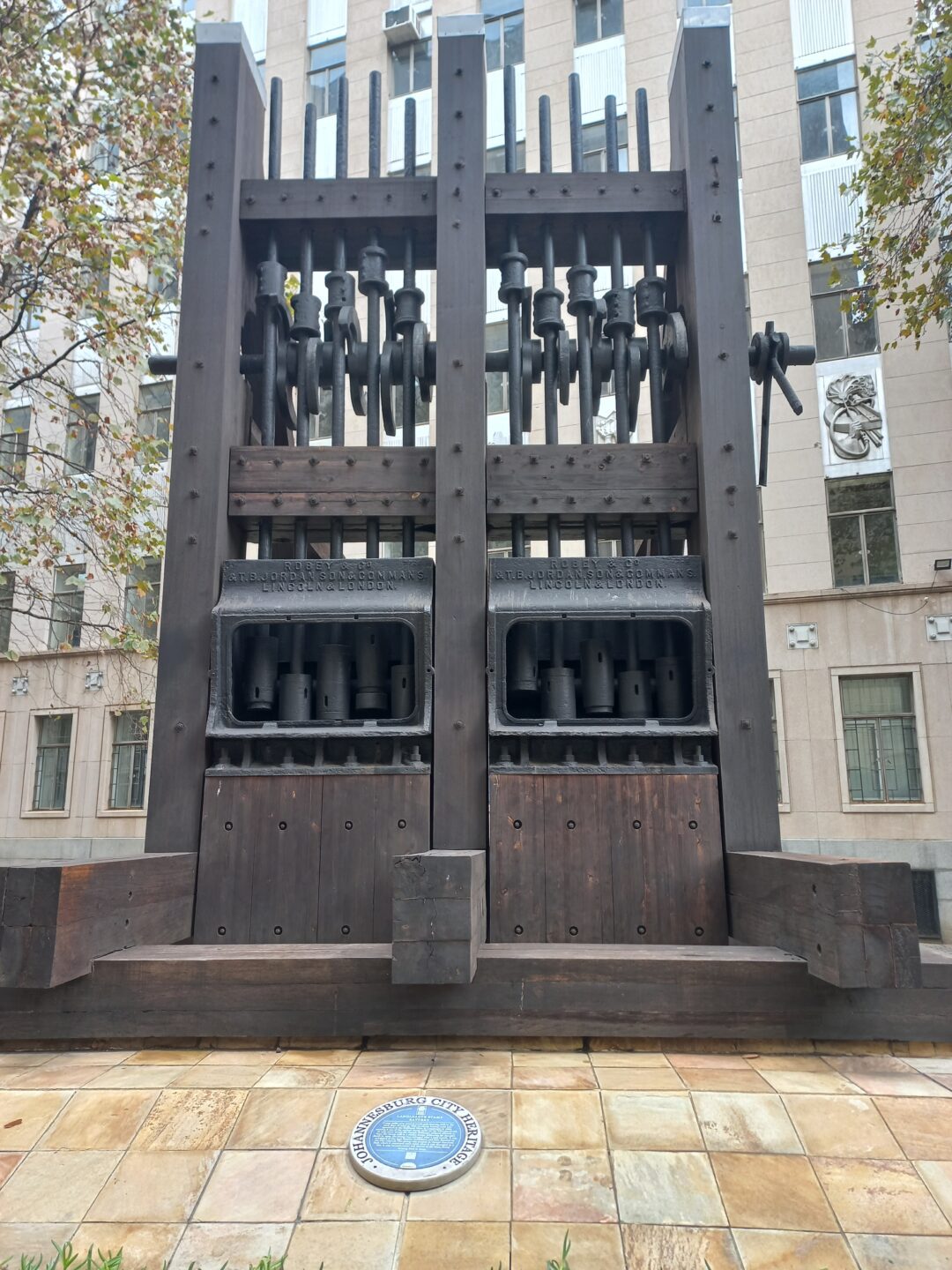
Ten Stamp Mill.
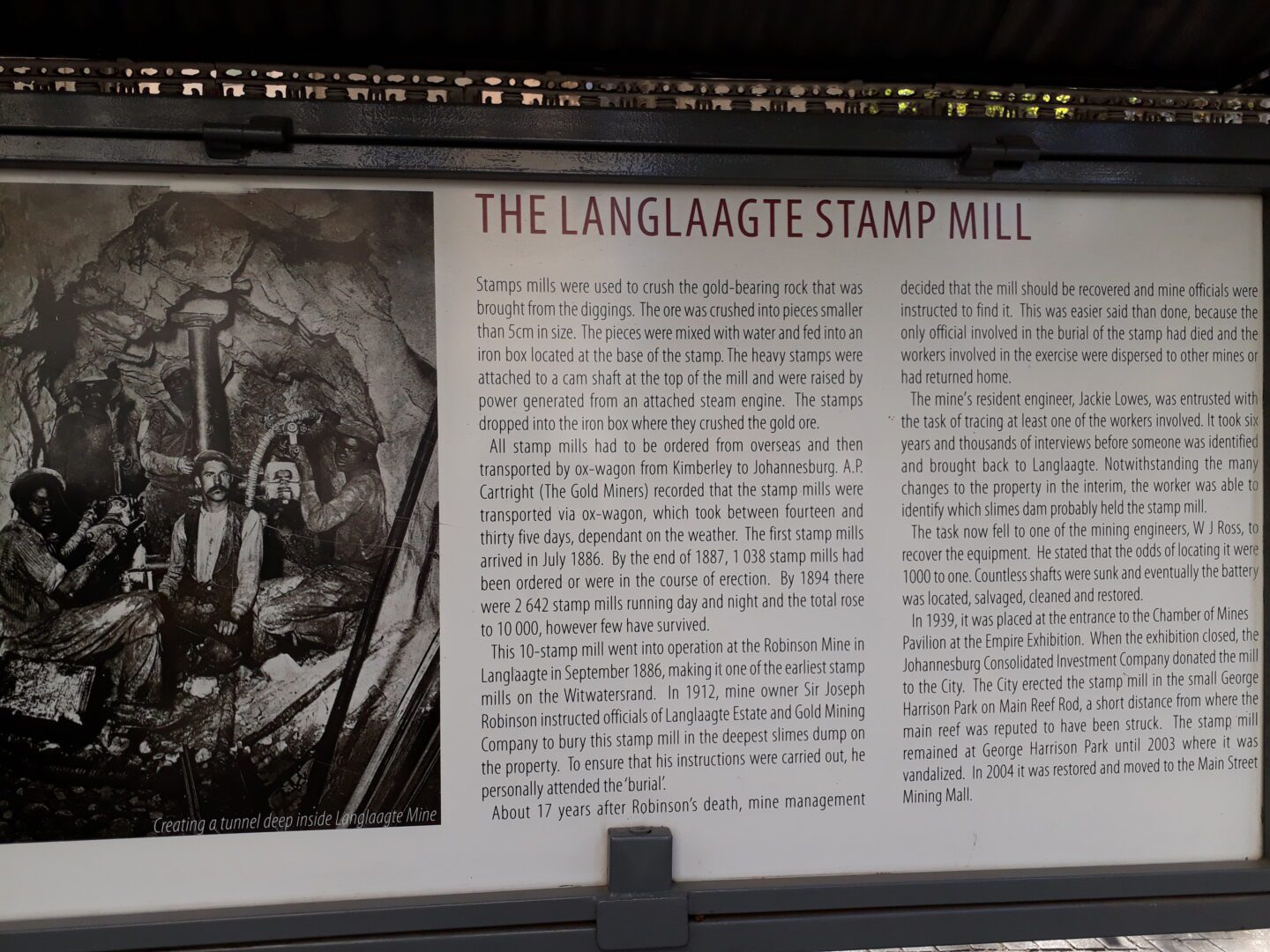
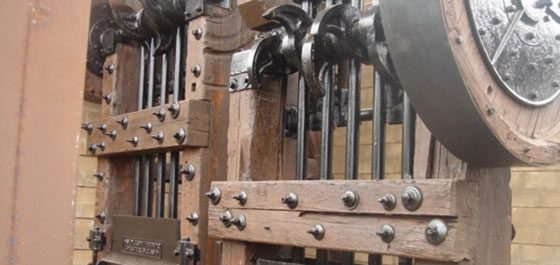
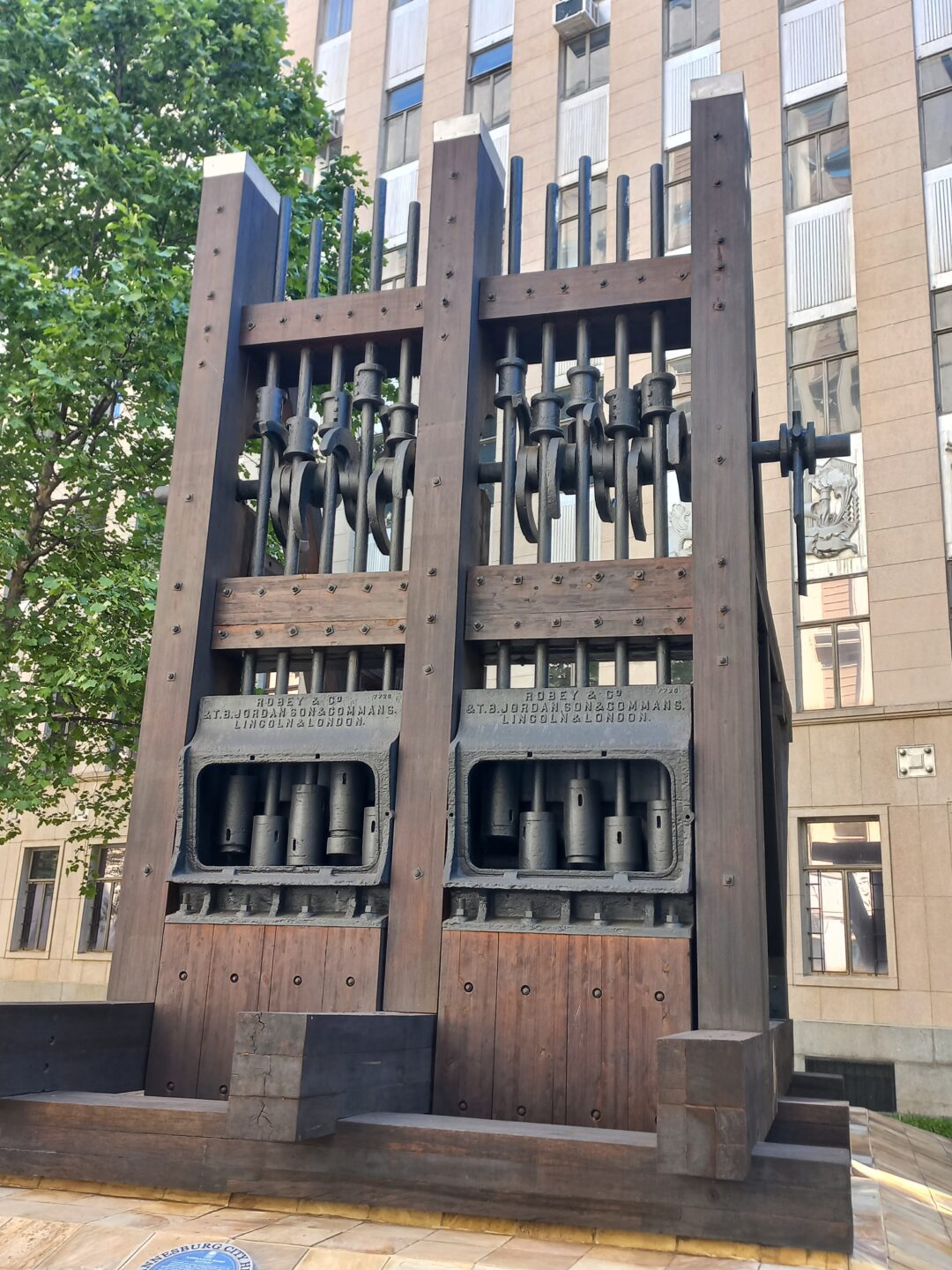
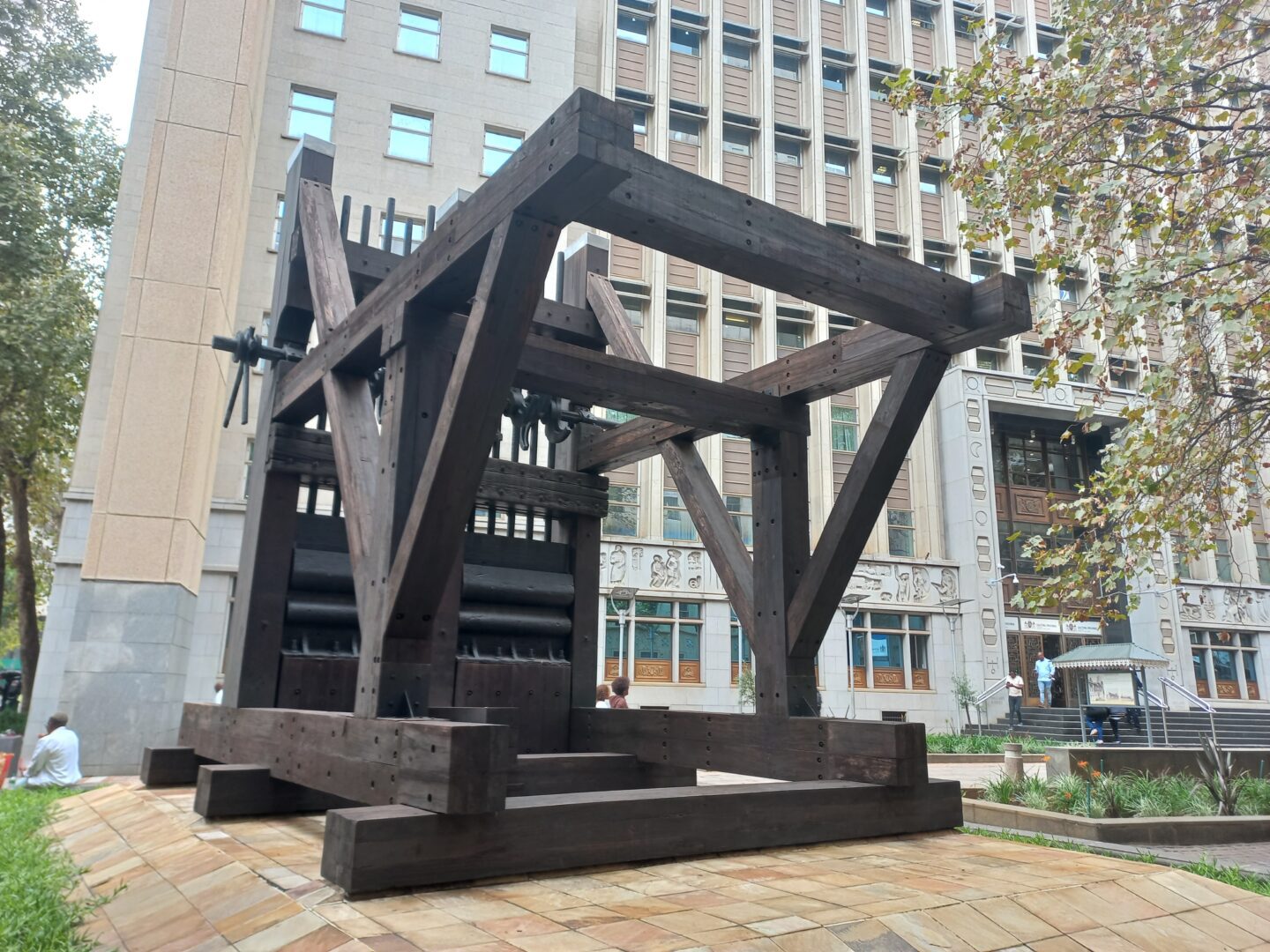
During the early days of mining, stamp mills were used to crush the gold-bearing rock that was brought from the diggings on the Witwatersrand. The ore was crushed into pieces smaller than 5 cm in size. The pieces were mixed with water and fed into an iron box located at the base of the stamp. The heavy stamps were attached to a cam-shaft at the top of the mill and were raised by power generated from an attached steam-engine. The stamps dropped into an iron box, where they crushed the gold ore.
All stamps had to be ordered from overseas, and then transported by ox-wagon from Kimberley to Johannesburg, which took between 14 and 25 days, depending on the weather. The first stamp mills arrived in July 1886. By the end of 1887, 1038 stamp mills had been ordered or were in process of erection. By 1894, there were 2 642 stamp mills running day and night and the total rose to 10 0000. Few of the old stamps have, however, survived.
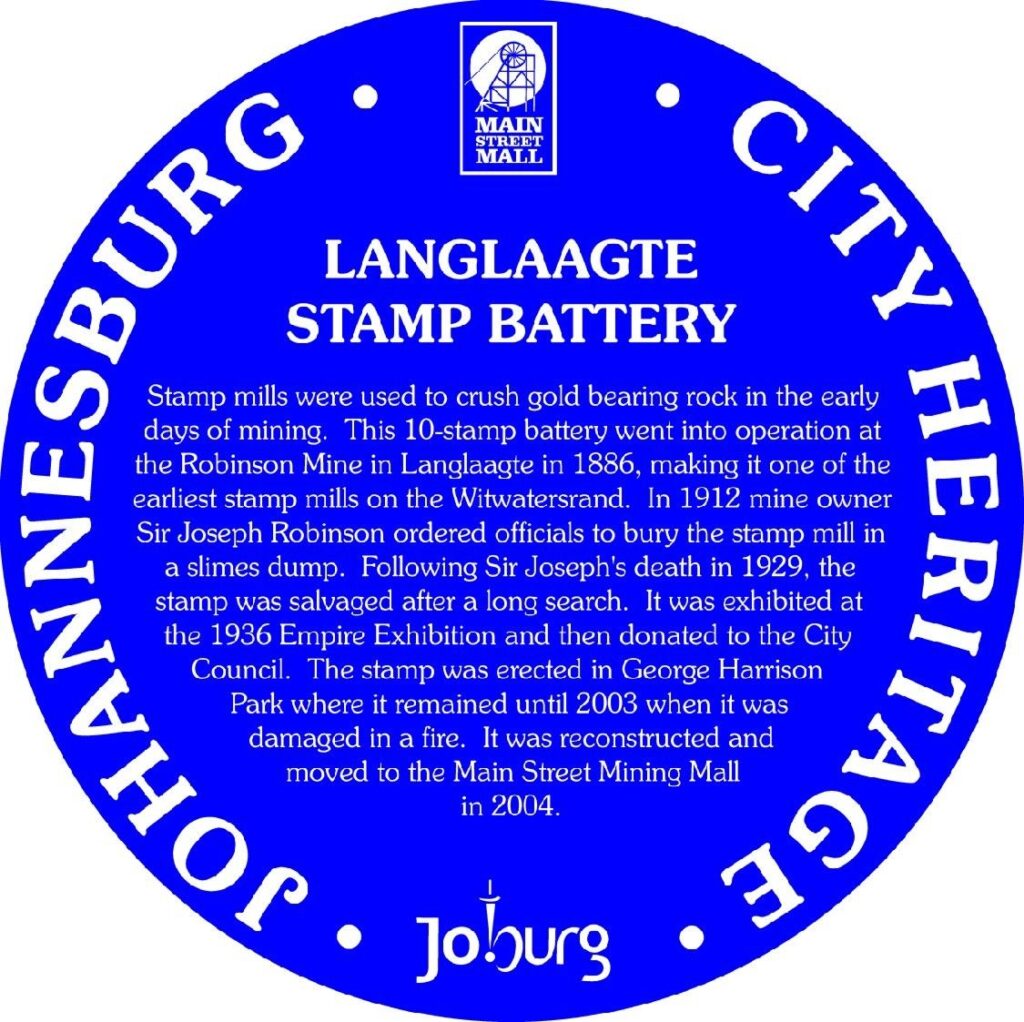
This 10 stamp mill went into operation at the Robinson Mine in September 1886, making it one of the earliest stamps on the Witwatersrand. In 1912, mine owner Sir Joseph Robinson instructed officials of Langlaagte Estate and Gold Mining Co to bury this stamp mill in the deepest slimes dump on the property. To ensure that his instructions were carried out, he personally attended the “burial”.
About 17 years after Robinson’s death, mine management decided that the mill should be recovered and mine officials were instructed to find it. This was easier said than done, because the only official involved in the burial of the stamp had died, and the workers involved in the exercise were dispersed to other mines or had returned home.
The mine’s resident engineer, Jackie Lowes, was entrusted with the task of tracing at least one of the workers involved. It took six years and thousands of interviews before someone was identified and brought back to Langlaagte. Notwithstanding the many changes to the property in the interim, the worker was able to identify which slimes dam probably held the stamp mill.
The task now fell to one of the mining engineers, W Ross, to recover the equipment. He estimated that the odds of locating the stamp mill were 1000 to one. Countless shafts were sunk and eventually the battery was located, salvaged, cleaned and restored.
In 1936, the Langlaagte Stamp Mill was placed at the entrance to the Chamber of Mines pavilion at the Empire Exhibition. When the exhibition closed, the Johannesburg Consolidated Investment Company donated the mill to the City authorities. The City erected the stamp in George Harrison Park on Main Reef Road, where the main reef was discovered. The stamp remained at George Harrison Park until 2003 when it was burnt in a fire. In 2004, it was restored and moved to the Main Street Mining Mall.
In an article on George Harrison park which appeared in The Star (5 June 1963), A P Cartwright noted:
“Just inside the gate is an ancient stamp battery, certainly one of the first to be used on the Witwatersrand, but not the first. It was found buried on the slimes dam on the Robinson Mine many years ago”
From 2004, the stamp mill was re-located to the Main Street Mining Mall, as one of several outdoor mining exhibits.
A culmination of research gathered over many years, the Online Johannesburg Heritage Register is being launched on Nelson Mandela Day 18 July 2025.
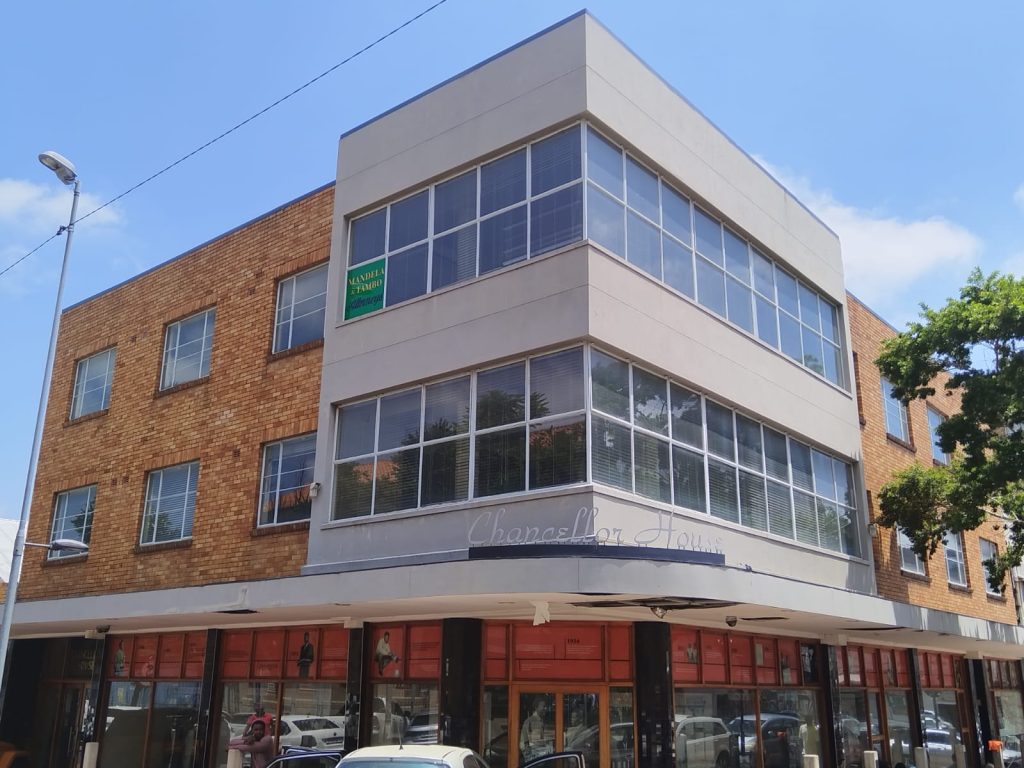
Among the many heritage sites featured is Chancellor House, the downtown offices of Mandela and Tambo Attorneys in the 1950s. After having been vacant and shuttered for more than a decade, this iconic building is being revived and brought to life once again as offices for the Community Development Department, which oversees the City’s Arts, Culture & Heritage Services.