
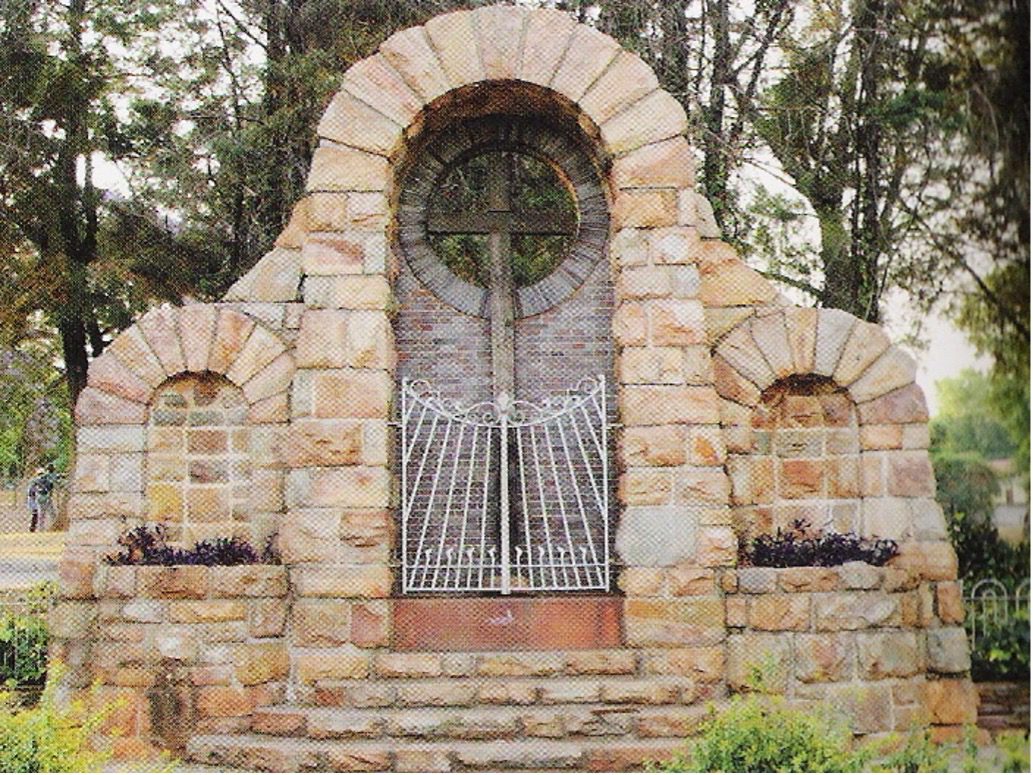
Symmetrical triple arched memorial constructed in fine hammer-dressed quartzite, the central, taller arch flanked by two smaller arches. The central semi-circular arch has an infill panel of blue face-brick pierced with a circular opening which provides a visual frame for the timber cross which in turn is protected at its base by a fine wrought iron screen. This screen is no longer in place. Broad hammer-dressed quartzite steps provide an elevated approach to the cross.
The two flanking arches are slightly set back from the central arch and likewise have an infill panel but in stone creating niches. Both arches are provided with a base of a semi-circular plinth which performs the function of a small flowerbed.
The wooden cross which forms the dramatic center-piece of the memorial was brought back from France after the Battle of the Somme.
There is planting behind the memorial and pine trees beyond that although in no formal relationship to the memorial. In front is a small stone court edged by low formal hedge.
Two rather ugly unplanted cement planters stand in the court, clearly a later and unfortunate addition.They are no longer there.
The memorial is now fenced and locked, although entry is possible.
The memorial, together with a suitable area of ground, should be retained. Any new developments in close proximity or on the main view lines should be considered by the Deputy-Director of Immovable Heritage and must reflect the scale and grain of the existing context and should not trivialize its setting. If no agreement is reached it must be referred to the Provincial Heritage Resources Authority of Gauteng.
The monument is dedicated to men of the 3rd South African Infantry (Transvaal and Rhodesia) killed in France in October 1916 during the Battle of the Somme. The date defines the action in which they died, the unsuccessful attempt by the 9th British division to take the Butte de Warlencourt – “the muddy hell where men were needlessly sacrificed for hardly any tactical advantage at all.” (SA Military History Society Newsletter No 334)
On 12 October 1916 (after the 47th London) division had been repulsed on 7th October), the 2nd South African Infantry Regiment was sent over the top. They were to go down the slope into the German trenches, take those and move up the Butte. Since the action was undertaken without adequate intelligence, the artillery attack which preceded the infantry one failed to knock out the German guns and the infantry crossed a sea of mud straight into enemy machine gun fire. Survivors were few, most were left dead or dying in the morass.
1 150 South Africans died in this action on the Somme between 9th and 18th October 1916.
The Battle of the Somme was the most futile battle of the First World War with horrific casualty rates and fought under the grimmest conditions of trench warfare where deaths from disease and exposure actually exceeded those from enemy fire. The action of the Butte de Warlencourt is more truly reflective of the Battle of the Somme than the heroic action at Delville Wood.
The Australian Archives include a photograph of a cross known as “The Crucifix” standing out amongst the tangle of graves. It is an appropriate symbol of what the commander- in-chief did to the men on the Western Front.
The cost of the memorial in Paterson Park was met by the Sons of England Patriotic Society, a patriotic and benevolent society whose membership was secret. Founded originally in Canada to promote friendship and patriotism amongst emigrants far from “Home”. SOE was established in South Africa in the 1880s and by 1910 there were 20 lodges in the country. In Johannesburg they founded the St George’s Home for Boys in Cleveland and they had a shelter for homeless children in Rosebank. It was not a militant organization and the secrecy which seems to have been a masculine obsession of that time, had a Biblical foundation - good deeds should be done anonymously, without expecting the beneficiary to be under an obligation and without glorifying the doer. It is a philosophy which may seem incomprehensible in current times where donors’ names are emblazoned on T-shirts, caps, advertising hoardings.
There is no record in the minutes of the Johannesburg Council between 1910 and 1939 of the memorial nor any mention of it in the Mayor’s minutes. The Mayor mentions the visit of Major General Sir HT Lukin in June 1920 attending the Delville Wood Memorial. It is possible that as the South African troops served under him, he would have been invited to inaugurate it.
From the available records, it is not clear why Paterson Park was chosen as the location.
Protected under Section 37 of the National Heritage Resources Act: Public Monuments and Memorials. “Public monuments and memorials must, without the need to publish a notice to this effect, be protected in the same manner as places which are entered in a heritage register …”. Since the Sons of England First World War Memorial is older than 60 years, it is also protected in terms of Section 34 of the same Act.

A culmination of research gathered over many years, the Online Johannesburg Heritage Register is being launched on Nelson Mandela Day 18 July 2025.
Among the many heritage sites featured is Chancellor House, the downtown offices of Mandela and Tambo Attorneys in the 1950s. After having been vacant and shuttered for more than a decade, this iconic building is being revived and brought to life once again as offices for the Community Development Department, which oversees the City’s Arts, Culture & Heritage Services.